Supply Chain Disruption: governed
A late or short shipment is assessed against stock; severe delays are rerouted and customers told, other cases get a mitigation plan. Adds built-in policies: a2a-v1-pii-detector, header-injection, mcp-pii-detector, mcp-schema-validation, rate-limiting.
| Style | Deterministic (Agent Network 2.0, AgentScript) |
| Kind | Governed |
| Agents / MCP servers | 4 / 3 |
| A2A protocol | 1.0, 0.3.0 |
| Policies | a2a-v1-pii-detector, header-injection, mcp-pii-detector, mcp-schema-validation, rate-limiting |
| Asset prefix | octo_sc2g |
| Tutorial | Supply Chain Disruption: governed: tutorial |
| Files | templates/v2-supply-chain-governed |
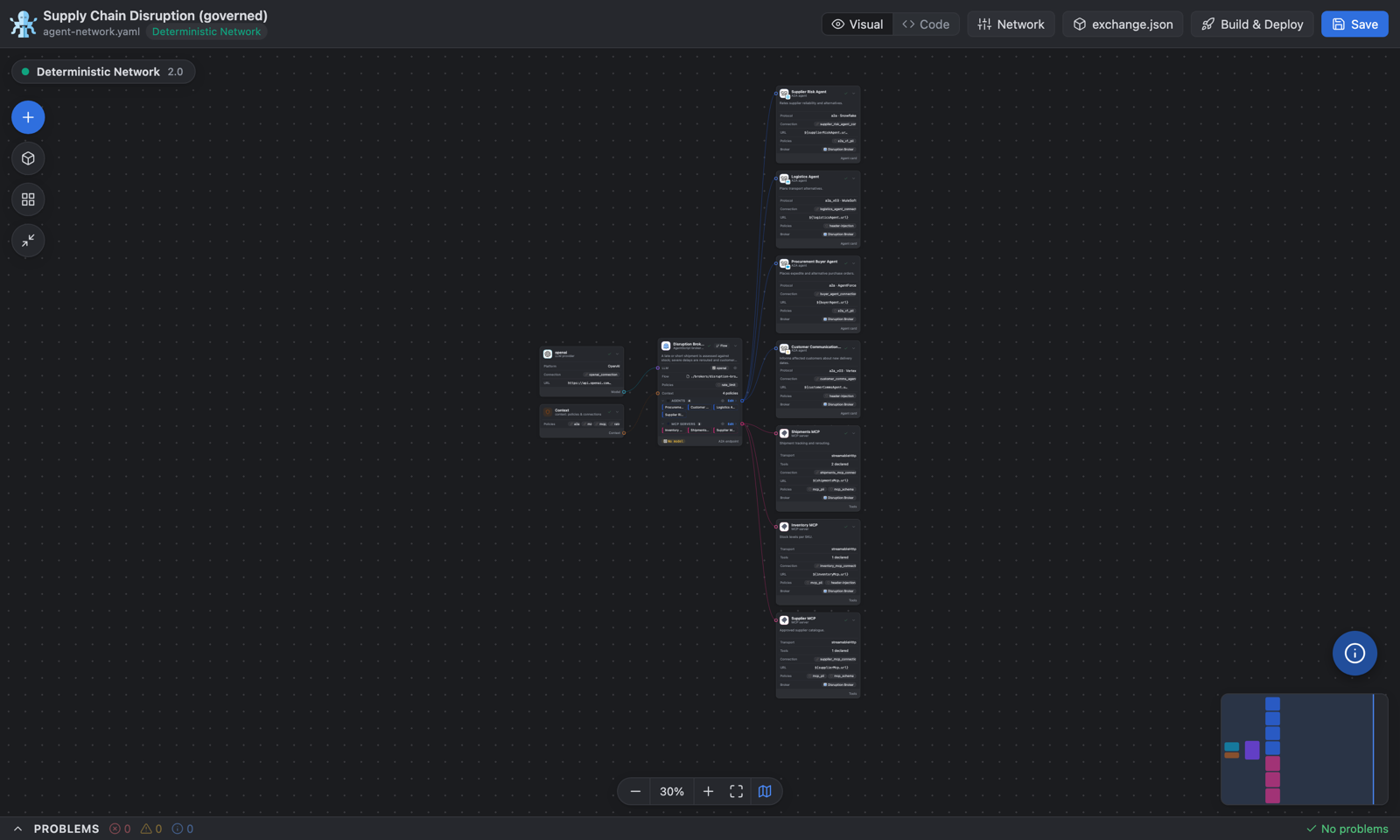 The network canvas
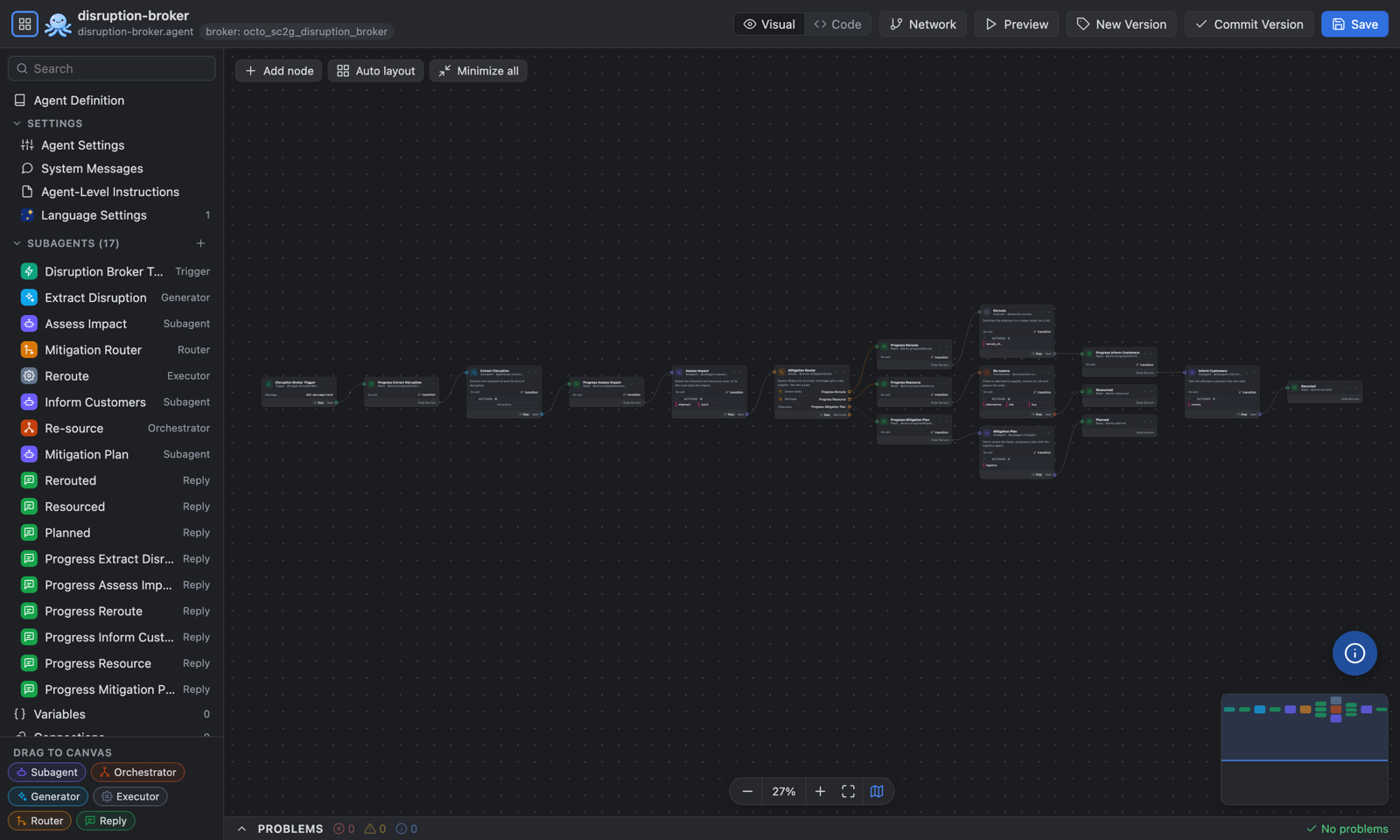 The broker flow (AgentScript)
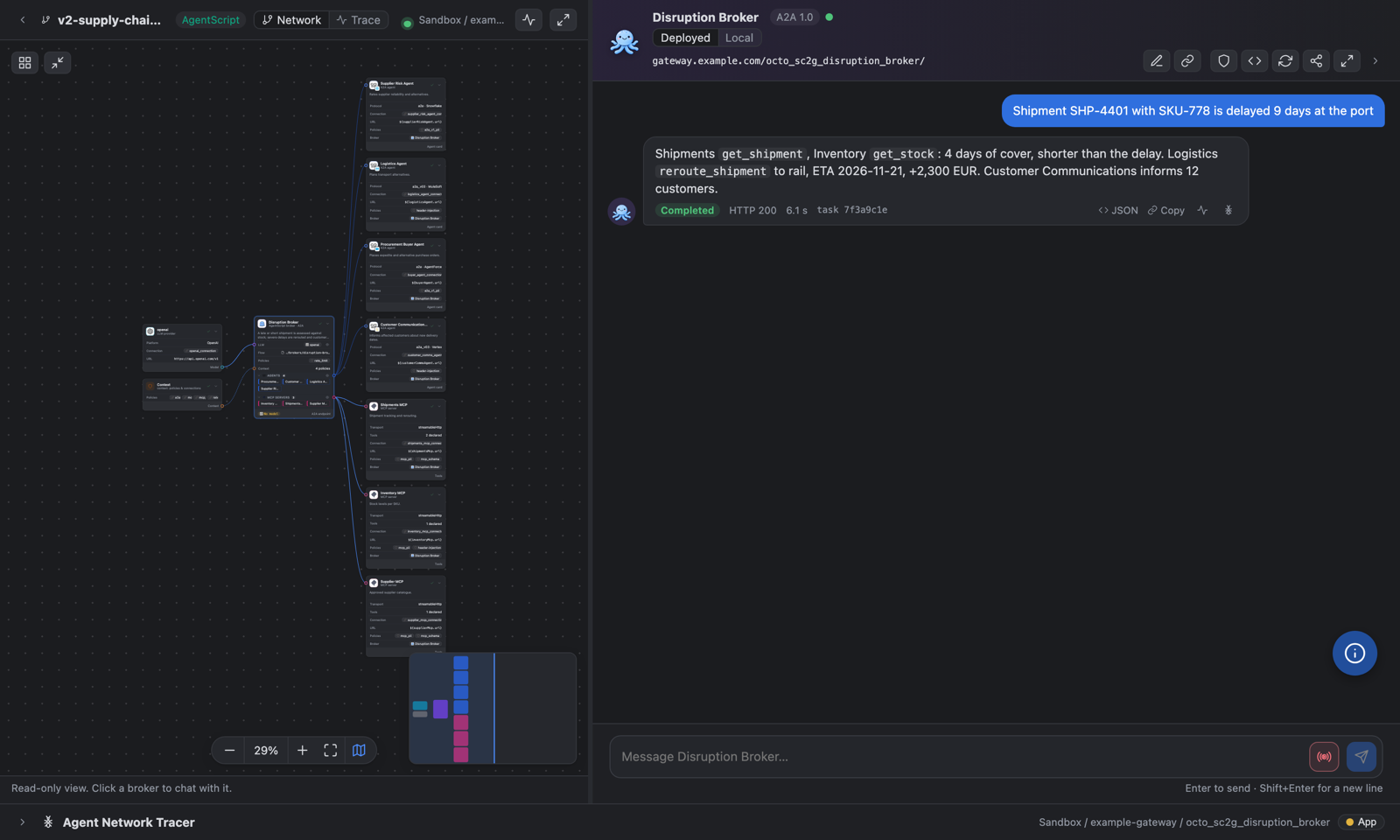 Chat with the deployed broker
A late or short shipment is assessed against stock; severe delays are rerouted and customers told, other cases get a mitigation plan.
- Style: Deterministic (Agent Network 2.0): an AgentScript flow in
brokers/decides each step. - Agents: Supplier Risk Agent (A2A 1.0, Snowflake), Logistics Agent (A2A 0.3.0, MuleSoft), Procurement Buyer Agent (A2A 1.0, AgentForce), Customer Communications Agent (A2A 0.3.0, Vertex)
- MCP servers: Shipments MCP (get_shipment, reroute_shipment); Inventory MCP (get_stock); Supplier MCP (find_alternative_supplier)
- Policies (Agent Fabric built-ins): a2a-v1-pii-detector, header-injection, mcp-pii-detector, mcp-schema-validation, rate-limiting. They are declared in agent-network.yaml and listed as
schemadependencies in exchange.json.
All agents and MCP servers are public A2D mocks, so the network runs without any other system. No credentials are stored in this template.
Deploy in 3 steps
- Setup & Connect: connect Agent Fabric (connected app client ID and secret, organization). A²D is not needed: the mock URLs are already the defaults in
exchange.json. - In Projects & Deploy, click Deploy on this project (or Build & Deploy in the editor) and pick your gateway. Octoloom asks for each secret variable; nothing you type is stored:
openai.apiKey: your OpenAI API key (required)- When the status light turns green (Deployed and running), click Open chat and paste a prompt below. The Tracer icon under a reply opens the task in the Agent Network Tracer, with each agent and tool call.
Try it
- Shipment SHP-4401 with SKU-778 is delayed 9 days at the port
- You should see: Shipments
get_shipment, Inventoryget_stock: 4 days of cover, shorter than the delay. Logisticsreroute_shipmentto rail, ETA 2026-11-21, +2,300 EUR. Customer Communications informs 12 customers. - Supplier reports a shortage of SKU-912 for shipment SHP-4402
- You should see: Inventory: 21 days of cover. Supplier Risk: SUP-12 is high risk;
find_alternative_supplier: SUP-31 in 5 days at +4%. Buyer places PO-66120 for 4,000 units, delivery 2026-11-18. - My email is jane.doe@example.com and my phone is +41 79 123 45 67. Shipment SHP-4401 with SKU-778 is delayed 9 days at the port
- You should see: Same answer as the first prompt. The PII detector policies log the email and phone number; on the MCP connections with the MCP PII detector they are masked before the tool sees them. Check the policy logs in Anypoint Monitoring.
- Send the first prompt more than 30 times within a minute
- You should see: The broker answers HTTP 429 (Too Many Requests) once the rate limit of 30 requests per minute is reached.
The broker is deterministic: the branches are fixed in the flow in brokers/ (open the .agent file to see them). The LLM only reads the ids from your prompt and writes the reply text, so the same input takes the same branch.